A LONG, LOST LAWREN HARRIS HAS BEEN FOUND


October 23, 1885 - January 29, 1970
background painting: Lawren Harris - Shacks
contact@autumnharbour.ca

Lawren Harris - Scientific

JMcelhon@Gallery.ca
To David Robertson and CHill@Gallery.ca
May 21 at 10:14 AM
Dear Mr. Robertson:
Charlie Hill has asked me to reply to you with regards to the use of Raman spectroscopy in identifying and distinguishing pigments and paints.
Raman spectroscopy is a method of characterizing molecules by observing the reactions of their chemical bonds to excitation caused by exposure to visible, near-infrared or ultraviolet light. As a method of instrumental analysis of molecular components, it is complementary to infrared spectroscopy. The thing often said about such spectra is that they are the “fingerprint” of the molecule, although that comparison may be stretching things a bit when it comes to real-world identification problems.
The critical requirement for the interpretation of Raman spectra is access to a library of spectra of relevant simple and compound materials. The web-based distribution and access to libraries of spectra has become much wider in recent years, but access and interpretation remain the province of experienced analytical scientists specialized in the particular type of materials under study. To my knowledge, Raman spectroscopy has been applied to the examination of oil paintings by several conservation science institutes (such as the Canadian Conservation Institute and the Getty Conservation Institute) and a handful of museums with scientific research departments (such as the Metropolitan Museum).
This message has been shortened for brevity.
That being said, I am not a scientist myself and you may be much better off carrying on your enquiries with someone who knows a lot more that I do about analysis of oil paints.
Hope this answers the first layer of your question to Charlie and good luck with your research.
Yours,
John McElhone
J.P. McElhone
Chief Conservator/Restaurateur en chef
National Gallery of Canada/Muséée des beaux-arts du Canada
Ottawa, ON CANADA
page link legends:
image
back to menu
zoom

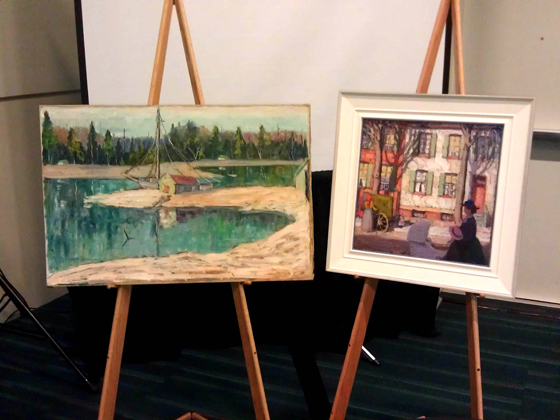
Research has shown that Autumn Harbour was painted on September 23rd, 1912. There is considerable historical, artistic and scientific evidence to support this finding. The first evidence is the historical weather records for this area. From Parry Sound (25 miles North of Go Home Bay) archival weather records, August and September 1912 would have been very nice weather with only a few rainy days. There was one storm at the end of August dropping 20.3 cm of rain over the two day period of Aug 31/Sep 1. The only major one day storm arrived on September 22nd when 21.3 cm of rain fell in one day.
The Great Lakes are known for their fall storms and the next year in November 1913, 19 ships were sunk and 248 people lost their lives, more that enough reason for a small pleasure boat to head for port when storms clouds arose. This second storm in September on Georgian Bay could have been the cause for pleasure boats such as a 45 - 60 ft slope to seek shelter. Go Home Bay could easily been a refuge for one such craft.
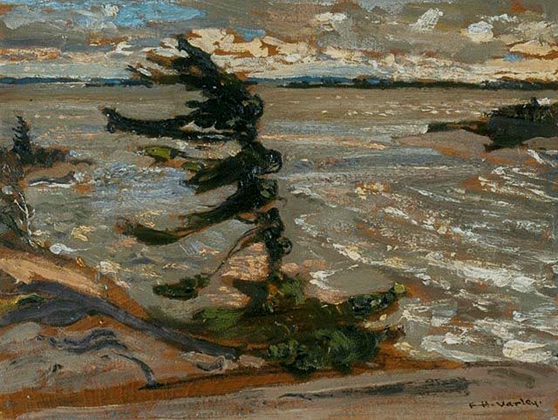
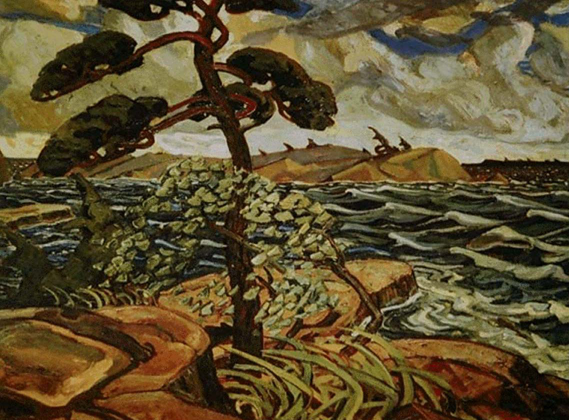
There is eve n a Group of Seven historical account of September storms at the mouth of Go Home Bay. In the fall of 1921 Frederick Varley and Arthur Lismer were visiting Dr. MacCallum’s cottage on Split Rock Island when a storm over a storm arose. The weather was especially blustery when both men wanted to paint the same scene just out the front door of the cottage facing Georgian Bay. One storm tossed tree over looking the mouth of Go Home Bay caught both their eyes as being a perfect subject for artistic capture. The dispute was settled that Varley would go left and Lismer went right. Varley’s painting Stormy Weather, Georgian Bay and Lismer’s A September Gale, Georgian Bay are excellent studies in how temperamental the Great Lakes weather can be in the fall.
There also exists a painting done by Tom Thomson showing the entrance to Go Home Bay that such a craft would have taken. His Cottage on a Rocky Shore, 1914 shows Dr. MacCallum’s cottage facing into Georgian Bay. It might even show at the right edge of the canvas the same tree that Varley and Lismer argued over. Thus it could have been such a storm that caused Harris to end his artistic drought. He could easily have looked for a suitable surface to paint such a scene and found an old stretcher that would hastily accept a piece of sailcloth. It probably was a larger canvas than what he might have preferred but it was available and easily covered with canvas.
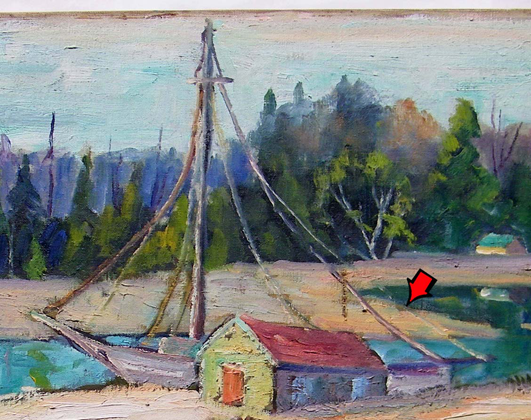
There is also a detail on the canvas that supports this conclusion. There is an error in the rigging depicted. Sailboats do not have lines running from the top of the mast to the end of the boom, which has been shown in Autumn Harbour. The cause for this error could have been two fold, Harris was not known to be a sailor and interestingly this line does exist on a sailboat when it is getting under way, it is the edge of the main sail. There are only three reasons why a sailboat would come into a dock. First, the dock is the home port or destination, second, for provisions or third, shelter. Go Home Bay in 1912 would be a very unlikely answer for the first two, there just wasn’t anything there of any real significance. The logical answer is that this sailboat had gone into Go Home Bay for shelter as Lake Superior and Georgian Bay were known for extremely bad fall weather. The storm of September 22nd answers this need. Harris probably arrived at his painting location on the morning of September 23rd. Enough time to setup, do the preliminary work of his canvas and the sailboat leaves. He was probably dropped off in the morning and would be picked up before dinner time. The sailboat was most likely painted from memory, thus the inclusion of the extra rigging line.
There is also another corroborating detail from the image on the canvas, the angle and length of shadows, especially from the back of the boat shed. September 23rd is the fall equinox and on this date the sun would reach a maximum mid-day height of 44.3E.
From these findings several points of evidence are revealed. First, Autumn Harbour was painted with pigments that would date from the period around 1912. Second, a direct match was found between a pigment on Autumn Harbour and a known Lawren Harris painting. Third, the blue pigment Lapis lazuli (Na, Ca)4(Al,SiO4)3(SO4,S,Cl) Spectrum 544 1001 1639 Library index 34 could have been a very expensive pigment that not every artist of that day could afford, after all it is made of ground up gemstone.
From just a few limited scans, this evidence strongly rules out Autumn Harbour having been painted by either an artist who happens to paint like Lawren Harris and anyone faking the work. Such an artistic doppelgänger painting in Harris’s style would have been discovered decades ago and nobody would have been faking Harris’s style and work before he was famous, especially with brand new and expensive pigments.
The question has been raised by some critics that this canvas could have been painted by someone else. Either faking Harris’s style or painting in his style accidentally. Thus the dating of the pigments becomes a crucial part of this examination. Several paintings have been mis-identified as Harris works, primarily because the works have been unsigned and the authenticators have not had thorough knowledge of Harris’s early styles. To avoid litigation I shall not identify these works that I have discovered in my research.
Historical Weather Records ●
Group Of Seven Historical Account ●
Error In The Rigging ●
Lapis Lazuli ●
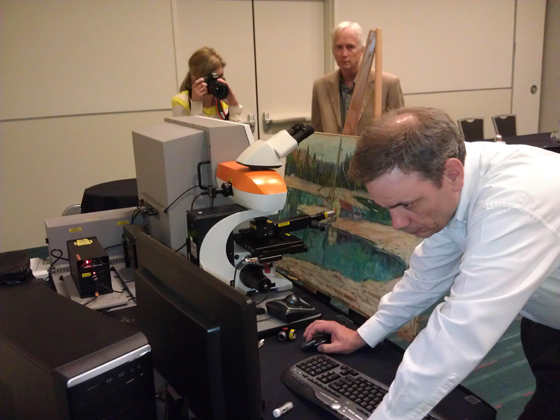
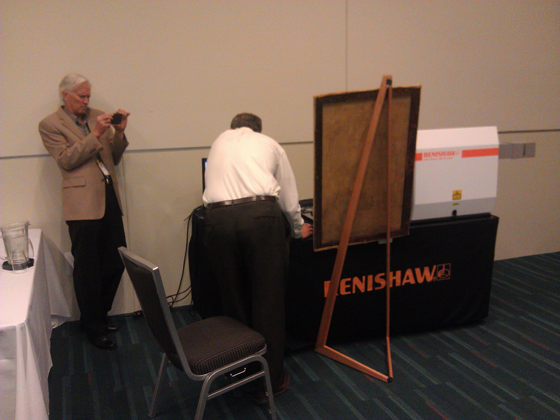
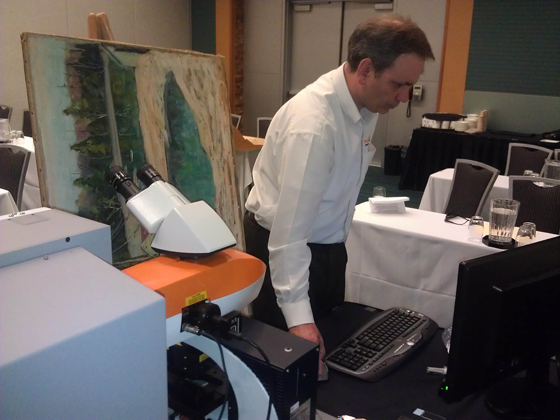
On June 4th, 2014 during the 97th Canadian Chemistry Conference and Exhibition at Vancouver Convention Centre in Vancouver, British Columbia, Dr. Richard Bormett of Renishaw took part in a Raman workshop which was organized and run by ProSpect Scientific, sponsored and resourced by both ProSpect Scientific and Renishaw. During this exhibition some demonstration scans were done on Autumn Harbour in comparison with Lawren Harris’s Hurdy Gurdy (sketch). Approximately seven scans were done on Autumn Harbour and four on Hurdy Gurdy. Several important results come out of these few scans.
The Fall Equinox ●
Raman Spectroscopy Workshop ●
Ground Up Gemstone ●
Charles C. Hill, curator ●
In reference to Raman Spectroscopy I did contact Charles C. Hill, Curator of Canadian Art, National Gallery of Canada and I got this reply.
John P. McElhone, chief conservator ●

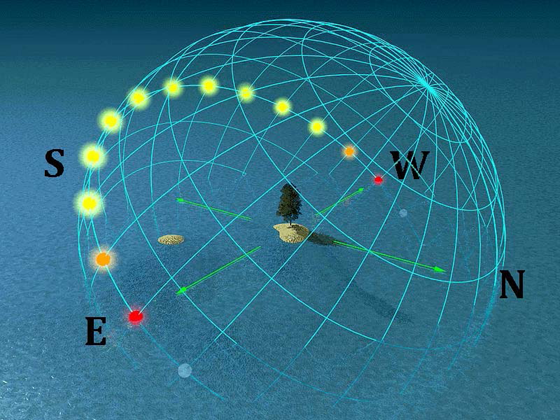

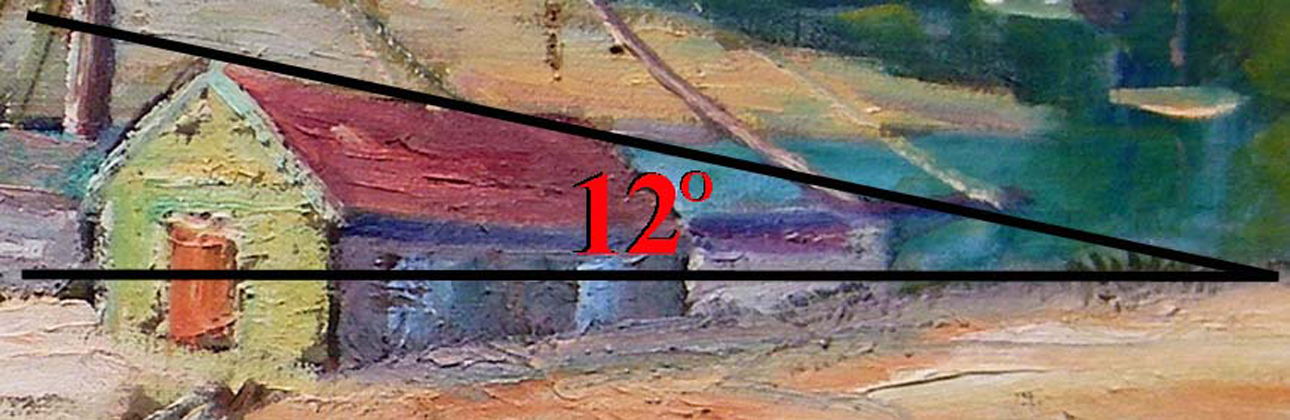
It is reasonable to assume that he would have finished this painting around 5-6 pm, the sun would set at a few minutes before 7 pm, at the time he finished the painting the angle of the sun would have been approx 15E to 10E above the horizon, which matches the shadow at the back of the boat shed.



Anatase TiO2 ●
The first result came from finding Anatase TiO2 (titanium oxide) in the white pigments of Autumn Harbour. Anatase was produced synthetically for use as a white paint pigment in 1906. As a pigment, titanium dioxide has some interesting physical properties: high refractive index, strong ultraviolet radiation absorption capability, whiteness, brightness, opacity & covering power. It was introduced in its artists' colour pallette by Winsor & Newton as early as 1910. It would have been available to Harris as a brand new pigment just before Harris and MacDonald left for their sketching trip to Mattawa and Temiscaming.
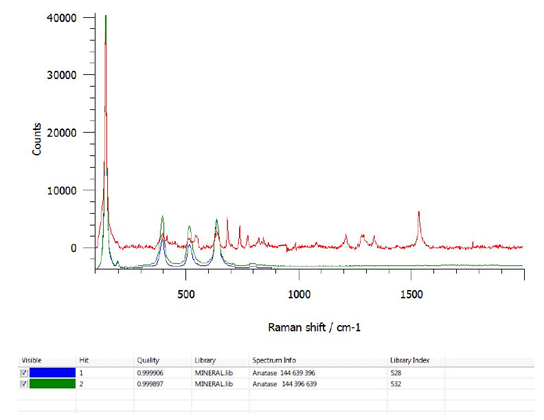
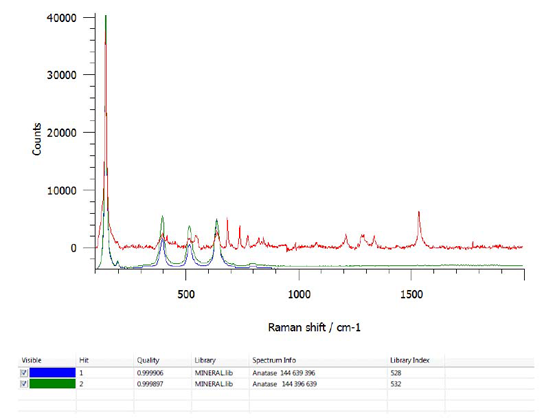
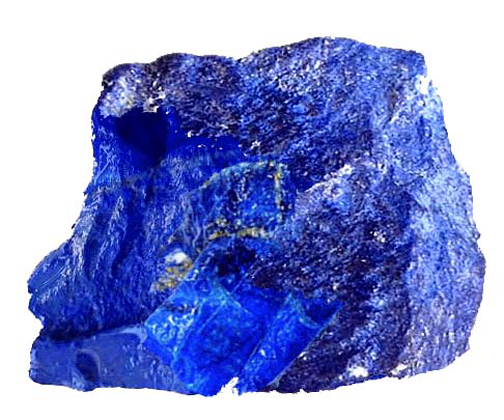
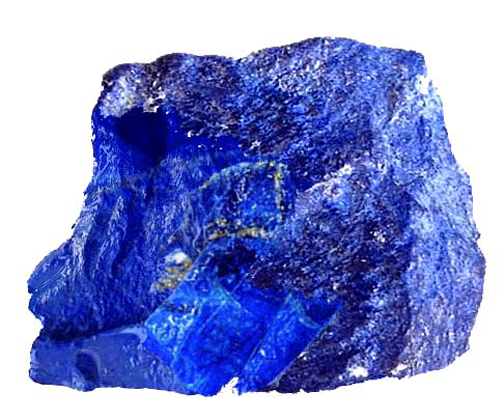
The second important finding was that Lapis lazuli (Na, Ca)4(Al,SiO4)3(SO4,S,Cl) Spectrum 544 1001 1639 Library index 34 pigment was found on both canvases. Natural ultramarine blue pigment is the ground, separated blue particles (lazurite) from the gemstone lapis lazuli. This was a time consuming process that produced varying shades of blue. The purest, deep blue was extracted in the first batch and sold for very high prices. In all the fractions, some transparent material is present (calcite) which aids microscopically in the distinguishing the natural from synthetic ultramarine pigments which were first made in 1828. Ultramarine blue is used as a pigment in paints (oil, tempera, watercolor, fresco), wallpaper, soap, textile printing, and laundry bluing agents.


Frederick Varley

Arthur Lismer

Tom Thomson

internet
Autumn Harbour
Scientific